Walmart Experience Quality Strategy • 2024-2026
Accessibility Champions and Training
I built training around recurring accessibility defects and a peer champion network so accessibility expertise could live inside every design team, not just with one specialist.
I Could Not Be the Only Accessibility Resource
When I became the accessibility-focused designer for the organization, the same issues surfaced review after review: low color contrast, inconsistent component use, accessibility considered too late. I was the primary resource, so every question routed to me.
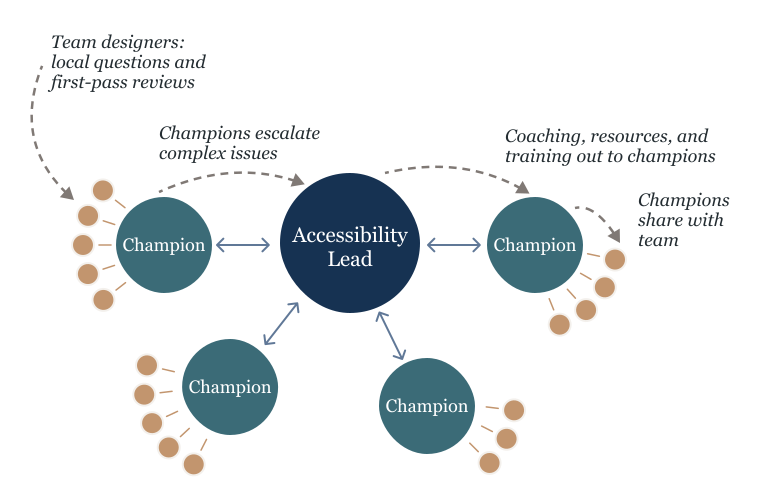
Answering them one at a time would never scale, and it made the whole organization depend on a single specialist. The durable fix was not a longer queue to one person. It was local expertise on every team. I built the program around a hub-and-spoke model: coach interested designers into accessibility champions, embed them on their own teams, and keep a clear path back to me for the hard cases.
Two Years of Training, Built to Spread
- 8
- Required weekly sessions in 2024
- 5
- Recurring defects targeted
- 2 grew to 5
- Named peer champions, original team to expansion
- 16
- Designers trained
Training Shaped by Real Defects, Not a Generic Curriculum
I did not teach the standards from top to bottom. I analyzed recurring defects and review findings, then built sessions around the five issues that showed up most: color contrast, labels and alt text, unique button labels, headings and hierarchy, and page titles. It was a small, concrete set designers could grasp and apply that same week.
The examples came from designers' own work, not abstract demos. Sessions paired live instruction with hands-on Figma annotation work, which designers had asked for directly, along with job aids and reference documentation. Session feedback and topic requests shaped what I taught next, so the curriculum tracked real failure patterns instead of a fixed syllabus.
The goal was behavior change, not attendance.
Champions Extended the System without Becoming Another Support Queue
The champions were designers who showed interest and aptitude. Some volunteered, some I recruited after they proved strong at the work, especially annotation. I coached them directly and gave them extra resources and time.
I kept their role deliberately narrow. Champions handled local questions, gave first-pass reviews, and reinforced expectations on their own teams. They did not replace expert review. The escalation path ran from self-review to champion input to my review, with leadership alignment when a call needed it. Complex issues always had somewhere to go.
A Champion Found Ten Issues before They Reached Me
One of my champions was relatively new to accessibility when she started. After she changed teams, she landed on a group that had run a single accessibility audit but never taken the findings back through design.
On her own, she identified roughly ten valid accessibility issues in the team's work and brought them to me for confirmation. She already knew how to fix more herself. The team addressed the issues. The escalation path worked exactly as designed: she did the detection, I confirmed it, and the team did the fixing.
The measure of success was never how many questions I could answer. It was how many I no longer needed to.
Designing the Program’s Next Stage
After a reorganization moved me to a larger design organization of more than 70 designers across five directors, I designed the program's next stage: a one-day accessibility training retreat for the newly merged team, followed by monthly sessions on more advanced topics. The group director sponsored it and encouraged bringing every designer together.
The retreat was planned and sponsored, but it did not run before my involvement ended. I count it as designed and endorsed, not delivered. What I did deliver was the two-year program for the original team of 16.
What Changed, and How I’d Measure It
In 2024, I delivered an eight-session required program for a team of 16, focused on five recurring accessibility defects. In 2025, I refreshed the content through an introductory session and longer, hands-on sessions with champion-supported group practice. I also defined the champion role and gave it to two designers on that team, so they could serve as local first points of contact while complex questions still had a clear path back to me.
The most meaningful outcome was a shift in where first-pass expertise lived. One champion’s story captures it: after changing teams, she independently identified roughly ten valid accessibility issues, brought them to me for confirmation, and already knew how to fix more herself. That was the behavior I was designing for: people who could spot and act on accessibility problems before every question reached the specialist.
The program created a repeatable training rhythm and gave the original team a local starting point for accessibility questions. When the organization expanded to 70 designers, the named peer champion group grew from two to five. I met with the three new champions once before my involvement ended, so that next phase remained a starting point rather than a delivered expansion.
If I were setting the measurement plan today, I’d establish a baseline for recurring defects, track progress by team, and measure how often champions helped resolve issues before escalation.